
A DEMOCRACY HAS NO CHANCE OF EVER LASTING MORE THAN ONE, POSSIBLY TWO GENERATIONS AND IS WILL NOT LAST IN THE EU, BUT RETURNING TO FASCISM AND NATIONAL SOCIALISM [NAZI] IS NOT A SOLUTION. MODELING A SYSTEM AFTER A US STYLE CONSTITUTIONAL REPUBLIC IS THE ONLY SOLUTION TO FREEDOM AND LIBERTY. THE USA IS ONLY IN TROUBLE BECAUSE FOR THE LAST TWO PLUS GENERATIONS, THE US GOVERNENT HAS MAINLY BEEN RUN BY CLOSET SOCIALISTS AND OUTRIGHT FABIAN SOCIALISTS, WITH THE EXCEPTION OF TWO, POSSIBLY THREE PRESIDENTS.
A Return to Populism and Nationalism
[As IN GERMAN NAZI PARTY AND ITALY’S FASCISM PARTY]
There’s already a foretaste of such a scenario. The EU has long since lost its role as a force for order in Eastern Europe. From the Baltic States to Bulgaria, hardly an Eastern European country truly stands behind EU projects.
REUTERS
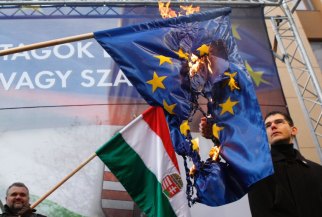 Hungary is almost broke and has lurched to the right so sharply that the EU has launched legal action in defense of democracy. But the problem is far more widespread: Nationalists and populists are gaining ground across Eastern Europe.
Hungarian Prime Minister Viktor Orbán only needed a few years. In that short time he managed to turn his country inside out. Civil liberties and press freedoms were reined in, the democratic separation of powers annulled, and a constitution passed in the spirit of the country’s former authoritarian-nationalistic leader MiklósHorthy.
Hungary is politically isolated in the European Union, and on the verge of national insolvency. And now the European Commission has launched legal action against the country. Brussels sees Orbán’s constitutional reform as a violation of EU law, and is threatening to deny economic aid to the heavily indebted country. It’s a remarkable development for a country once seen as a model for reform to be emulated by other countries in the region.
Orbán himself, formerly a much-admired politician, now seems like a dubious mix of Vladimir Putin and Hugo Chávez. But the diminutive politician from the tiny northwestern Hungarian village of Alcsútdoboz is by no means a special case. Orbán and his Hungary represent a political movement that is sweeping across central and southern Europe.
Hungary is an object lesson for the tragedy of societies in transition. A change in the elites in the state apparatus and economy never happened after the voluntary exit of Hungary’s communists and the much vaunted peaceful revolution of 1989-90. Following a short period of euphoria over the end of the dictatorship, the Hungarian economy suffered a swift and sustained collapse, and hundreds of thousands were suddenly unemployed. As a small group of old-yet-new elites enriched themselves with the often dubious, criminal privatization of former public property, the rest of the population was forced to suffer repeated economic and social shock therapies. This meant that few attempts to reform national and public finances were ever seen through.
The socialist-liberal coalition government in office between 2002 and 2010 solved none of Hungary’s pressing problems, excelling instead at protracted political disputes, mismanagement and corruption. Without these eight lost years, Orbán and his right-wing nationalist Fidesz Party would not have earned their overwhelming two-thirds election victory in April 2010.
‘A Real Problem’
Bulgarian political scientist Ivan Krastev views Orbán’s policies as a “very serious attempt to solve Hungary’s crisis through nationalist means,” but warns against dismissing the Magyar leader as a madman. “Orbán and his model are generally underestimated in the West,” he says. “Right now Hungary’s neighbors are looking at Budapest with reservation. But what happens when a government has nothing left to offer but such a nationalistic model? If even four or five countries in Eastern Europe do the same thing Orbán has done, then the EU has a real problem.” [AND THE US MEDIA IS REFUSING TO REPORT ON IT!]
Read more: http://www.spiegel.de/international/europe/0%2c1518%2c809827%2c00.html


 a12iggymom's Blog
You must be logged in to post a comment.